Four days ago, I called Bipin Sir. I have always addressed him as “Bipin Sir.” His name is Bipin Mohanty. I was calling to invite him to a Trainers’ Meet that was to be held in Bhubaneswar.
He said, “I won’t be in Bhubaneswar on the 30th. I’m going to Dhenkanal. There’s a Creators Meet there.”
I immediately became excited. First, I did not know that a Creators Meet of this kind was being organised in Odisha. Second, it was happening in Dhenkanal, not very far away. Then, it was a Sunday. And most importantly, I had never spent so much time with Bipin Sir.
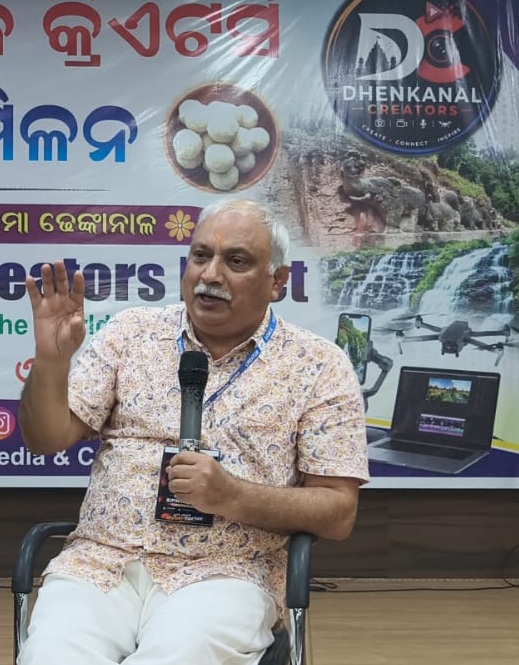
I have been following his work, his ideas, and the many ways in which he has contributed to society for a long time. So, quite suddenly, I found myself wanting to spend some time with him, to have a long conversation and, at the same time, get an opportunity to attend the Creators Meet.
I asked, “Sir, can I go with you?”
His answer was simple: “Yes. Why not? I am always looking for someone to travel with me.” That settled it.
We left for Dhenkanal on Sunday morning.
As we travelled, Sir began sharing bits and pieces of his creative journey. He spoke about how he became associated with DaanUtsav, how he worked on its campaign across India, and how he became involved with ideas like Design for Change, among many other things.
For me, the journey was no longer simply a trip to Dhenkanal. It was an opportunity to listen, up close, to a person’s way of thinking, his creative journey, and the way he looks at society.
Before we knew it, we had reached Dhenkanal.
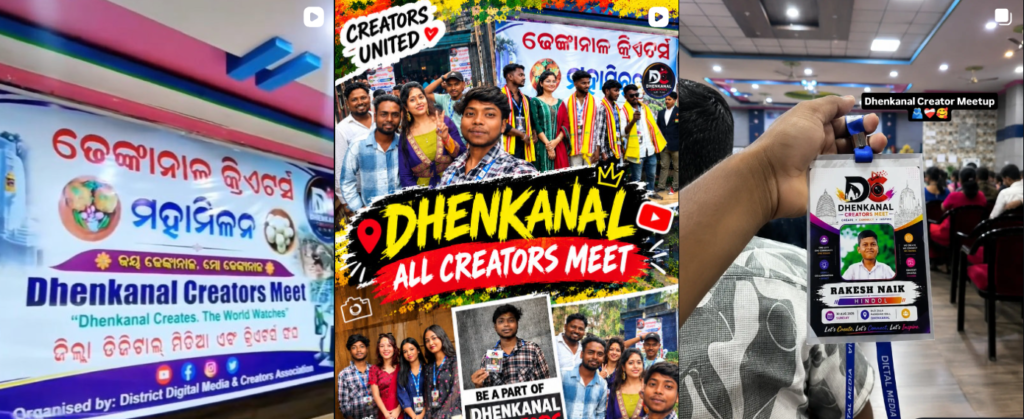
When we entered the Jilla Parishad Hall, I was surprised. The hall was packed. There were young men and women everywhere – roughly 70 per cent boys and 30 per cent girls. Some were creating content for social media, some were writing, some were taking photographs, and others were making videos. There was a visible excitement among everyone to create something new.
I was neither in the list of Guests or in the list of participants. As far as the organisers knew, someone was simply accompanying Bipin Sir. Sir’s was the first session.
After the welcome, he suddenly said to me, “Stay with me on the stage. Give a short introduction about me – whatever you know. Since you are curious to hear and learn from me, ask the questions you want to ask. We will take the session forward through questions and answers.”
I sat beside him on the stage.
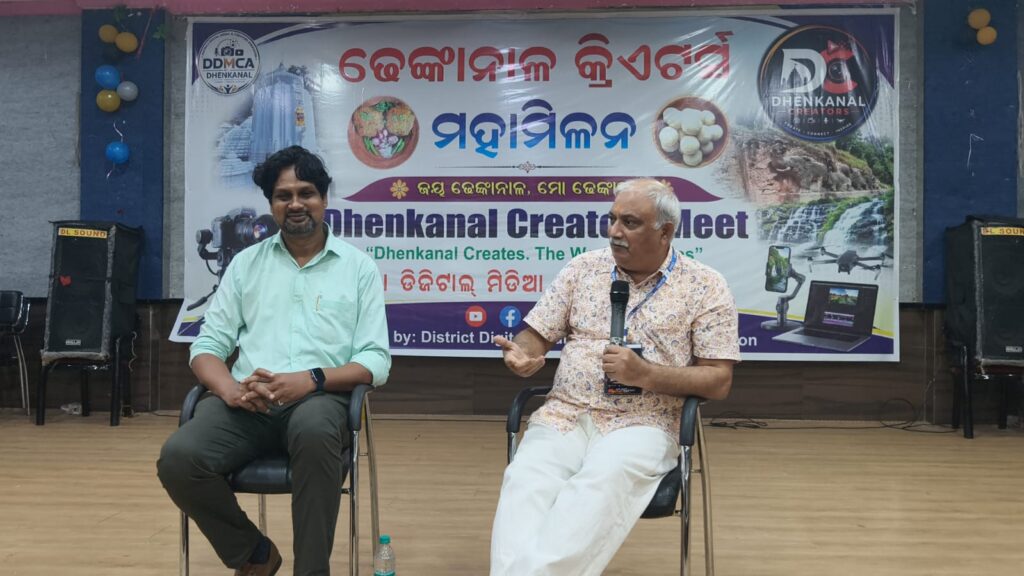
I gave a brief introduction, sharing whatever I knew about him. Then a question came to my mind: What exactly is a ‘Creative Mind’? How does a person become creative? Where did your own creative journey begin? What are some of the creative things you have done? And which of your works has influenced you the most?
The answer he gave touched me deeply.
He said, “The world we live in was itself once a creation. The entire universe was once created. Creation, therefore, is one of the fundamental impulses of existence.”
At that moment, I realised that being creative is not simply about drawing, designing, making videos, or writing. Creativity is the ability to look at something differently – to see possibilities where others may see only a problem.
A creator is not merely a person with a particular profession or skill. It is the thought within, the imagination, the courage to ask questions, and the desire to create something new that makes a person a creator.
Looking at the hundreds of young people sitting in that hall, I realised something else that day.
Today’s young generation is not merely consuming content; they are creating it. They are telling their own stories, expressing their own perspectives, and experimenting with new forms of expression. To look at this only as a ‘social media trend’ would be a mistake. It could well be the beginning of a new, creative society.
Sir then spoke about how the world itself had evolved. Human beings existed on this earth, but the kind of social structure we understand today did not exist in the same form.
The definitions of relationships were not what they are today. People did not necessarily live permanently in one place. They moved from one place to another in search of food and survival. But over time, everything changed. Human thinking evolved, lifestyles changed, relationships changed, and gradually, society took shape.
That evolution is still continuing.
Think about our own generation. There was a time when we did not have mobile phones. Many of us did not even know what a computer was. And today? We use digital systems every day. We use Artificial Intelligence.
Behind every stage of this evolution have been countless creative minds.
Sir gave the example of Mahatma Gandhi to explain this.
During British rule in India, Gandhi had an idea: he would return to India and work for its freedom. He would bring people together against British rule.
After returning to India, he connected with people, wrote extensively, used newspapers and publications to create awareness and inspire people, and even started his own publications. He travelled across India, met people, and spoke to them.
He had a clear goal, to make India free.
But he did not have weapons with which to fight the British. Instead, he chose a different path, non-cooperation, non-violence and mass movements.
That, Sir explained, is the power of a Creative Mind.
To look at a problem differently from the way everyone else is looking at it and from that different perspective, discover a new way forward.
Sir then shared another example from his own life.
“In 2009, a few of us came together and started DaanUtsav, the Joy of Giving Week, in India. Think about any festival. We usually do not know the name of one particular founder of Holi or Diwali. In the same way, we started DaanUtsav as something that belongs to everyone. It is not one person’s festival; it is everybody’s festival.
“Perhaps that is why it has no office. What it has is an idea, the idea of turning the joy of giving into a celebration. And today, millions of people participate in that celebration.”
He also spoke about how, during the COVID-19 pandemic in 2020, he used social media platforms to raise ₹32 lakh through crowdfunding to support auto-rickshaw drivers in Bhubaneswar.
Sir then spoke about Design for Change.
He explained how, during DaanUtsav, Kiran Bir Sethi of Ahmedabad, an alumna of the National Institute of Design and founder of Riverside School, asked herself: What can I do during this Joy of Giving Week?
That thought gave rise to Design for Change.
The idea was simple yet powerful: give children in schools across India the opportunity to identify problems around them, think of solutions, and actually put those solutions into action.
There were four steps:
Feel. Imagine. Do. Share.
First, feel and recognise a problem around you. Then imagine a possible solution. Discuss it, plan an action and put that solution into practice. Finally, share your experience and your story of change with others.
It was not merely a competition. It was a process of helping children understand that they are not just students who come to school to study; they are also responsible members of their communities.
And the idea did not remain limited to India. In time, people in different countries began working with the same approach.
What I liked most about Sir’s explanation was the larger meaning behind it: creativity is not the privilege of a particular class or profession.
A government employee can find a new solution to a problem within a department. A student can find a solution to a problem in school. An ordinary person can look at a problem at home differently and find a better way of dealing with it.
Wherever the problem may be, what matters is the willingness to think about a solution.
Sir gave another example that made me think deeply, the Gangua River in Bhubaneswar.
Many people living in Bhubaneswar did not know that what is commonly referred to as the Gangua drain was once a river. Its earlier name was Gandhabati. With the growth of the city and over time, it gradually took the form of a drain.
Professor Binayak Rath had written about it. After reading his work, Sir began thinking: How do we explain this to people?
He prepared a detailed map. He organised a press meet. He used the media to bring the issue into public conversation. In other words, when you see a problem, you do not simply remain silent. You question it. You look for facts. You inform people. And you try to find a solution.
He also shared an interesting experience of meeting the Governor with the map. He recalled how the Governor looked at the map and read ‘Gangua’ as ‘Ganga’, and how, in the effort to correct this misunderstanding, more than ₹8,000 crore has now been earmarked by the Odisha government for the river’s restoration.
As I listened to all these examples, I kept thinking that the ‘Creative Mind’ Sir was talking about was not merely about design or art. It was a way of looking at life.
Sitting beside him on that stage in Dhenkanal that Sunday, I understood something simple: every great change begins with a small thought.
And that thought is born in a Creative Mind.
Sir also said something else that stayed with me. Everyone is equal, and everyone has the potential to be creative. The important thing is to bring that creativity out and use it. Just as a seed needs the right environment to grow into a tree, our creativity also needs the right environment to flourish.
He said something else beautifully: even while we are busy working, we must make time to learn. It could be an hour every day or two hours a week. The important thing is to keep learning.
On our way back, I asked him why he had not spoken about the other aspects of social media—how to earn from it, how to build a brand, how to increase viewers, or the legal issues involved.
He replied that there were resource persons for those subjects, and they would take them up later.
For me, that Sunday was not just another Creators Meet.
It was an opportunity to know a person a little more closely. And, perhaps more importantly, it was a small opportunity to rediscover the Creator within myself.
The journey with Bipin Sir may have lasted only a day, but the conversations of that day will stay with me for a long time.