India must urgently recognise prosthetic care as a core pillar of public health, social inclusion, and national productivity, according to a new policy paper titled “Fixing the Mobility Divide: A Policy Roadmap for Accessible Prosthetic Care in India.” The paper has been prepared by Parashar Industries, in collaboration with the Kailash Kher Foundation, and was launched today for policymakers, government institutions, and key stakeholders.
 |
India Needs a National Prosthetics Mission to Bridge the Mobility Divide, Says New Policy Roadmap
The policy roadmap makes a compelling case for establishing a National Prosthetics Mission and integrating comprehensive prosthetic care under Ayushman Bharat, arguing that mobility is not a matter of charity but a fundamental enabler of dignity, economic participation, and national resilience.
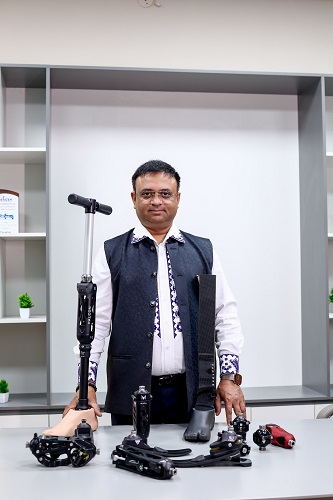 |
Nagender Parashar, Director, Parashar Industries
India witnesses a staggering number of amputations each year, driven by road accidents, diabetes, industrial injuries, and defence-related incidents. Yet, access to quality prosthetic care remains deeply fragmented, urban-centric, and unaffordable for a majority of citizens. Advanced prosthetic devices often cost several lakhs of rupees, while insurance coverage and long-term rehabilitation support remain inconsistent across states.
The policy paper highlights that without a unified national framework, amputees-whether soldiers, workers, or civilians-are frequently left dependent on fragmented services, outdated devices, and prolonged rehabilitation cycles. It calls for prosthetics to be treated as national infrastructure for human capital, aligned with the vision of Atmanirbhar Bharat and Viksit Bharat 2047.
Key Policy Recommendations
The roadmap proposes:
-
Launching a National Prosthetics Mission to coordinate healthcare, defence rehabilitation, social justice, and skilling.
-
Full integration of prosthetic care-including fitting, follow-up, and maintenance-under Ayushman Bharat and other public insurance frameworks.
-
Strengthening indigenous manufacturing through Make in India, MSMEs, and innovation clusters to reduce import dependence.
-
Establishing district-level prosthetic and rehabilitation hubs to bridge urban–rural disparities.
-
Linking prosthetic rehabilitation with employment, skilling, and mental health support to ensure long-term reintegration.
Nagender Parashar, Director, Parashar Industries, said, “Prosthetics are not optional medical devices—they are instruments of dignity and productivity. Every amputee who regains mobility also regains the ability to contribute to the economy and society. A National Prosthetics Mission is not welfare; it is nation-building.”
Pilot Neeraj Sehrawat, Chief Strategy Officer, Kailash Kher Foundation, added, “Our work on the ground shows that lack of access to prosthetics traps families in cycles of dependency. Integrating prosthetic care into Ayushman Bharat will ensure that no citizen is denied mobility because of income or geography.”
Former Lok Sabha MP Dr Kirit P. Solanki noted, “This roadmap rightly places prosthetics at the centre of public policy—linking healthcare, indigenous innovation, and social justice. Universal access to prosthetic care is essential for an inclusive and progressive India.”
Prof. N.K. Ganguly, former Director General, ICMR, highlighted that prosthetic care must move beyond device delivery to holistic rehabilitation, supported by strong standards, skilled professionals, and outcome-based monitoring.
Nitish Sharma, Co-founder, PASG Advisory, said, “This policy roadmap provides a clear, implementable framework for government and industry. Integrating prosthetics with Ayushman Bharat and aligning it with indigenous manufacturing can transform India into a global hub for affordable and advanced prosthetic solutions.”
A National Imperative
The paper argues that investing in prosthetic care yields long-term economic dividends-by restoring livelihoods, reducing welfare dependency, strengthening defence rehabilitation, and creating a globally competitive manufacturing ecosystem.
As India positions itself as a leader in inclusive growth and advanced manufacturing, the policy roadmap calls on the government to act decisively and treat prosthetic care as a strategic national priority rather than a peripheral health intervention.