For years, NCR’s housing narrative was anchored where value was measured in price points and access. Today, that paradigm is being rewritten. Homeownership is becoming an expression of aspiration, identity, and long-term lifestyle alignment. What was once considered “premium” has begun to move into the mainstream consciousness, not as an upgrade, but as an expectation. This shift is underscored by the fact that a significant share of recent housing demand in NCR is now concentrated in the Rs. 1 crore-plus segment, signalling that the market is evolving.
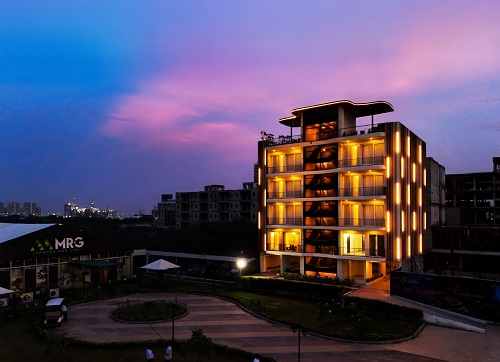 |
MRG Crown, Sector 106, Gurugram
Knight Frank India’s latest report has noted a notable change in the market where houses with a price tag of above Rs 10 million accounted for 50% of the total residential sales in the top eight cities of India in 2025. Out of a total of 348,247 units sold during the year, about 175,091 units belonged to the category of houses with a price tag of above Rs 10 million, which is an increase of 14% over the previous year, with sales volumes staying flat and high.
Besides, the definition of “premium” in NCR’s housing market is seeing a shift. It is no longer defined by a price bracket or a ticket price level; instead, it is being redefined in terms of experiences, design, and identity. Today’s premium home is just as much about experiences and living as it is about price. This is also reflected in the supply side, where an increasing proportion of supply is aligned to this new premium, and in the buyer profile, where there is an expansion of this market across a broader spectrum of price points. Premium, therefore, is no longer an economic definition but a conceptual one, based on how people want to live, and not merely on what they can afford.
Another aspect of equal importance is the emergence of a new form of a premium homebuyer, whose characteristics have moved beyond just a high net-worth individual. A staggering 63% of homebuyers today classify real estate as a preferred investment option, which reflects a more financially savvy approach to homebuying. This trend is now being fueled by dual-income households, along with a new set of wealth creators from startup economies and GCC-led employment growth. What is particularly telling is the widening participation across ticket sizes, from the Rs. 1–3 crore bracket to higher-value segments, indicating that premium housing is no longer the preserve of legacy capital. Instead, it is being shaped by an aspirational, upwardly mobile buyer class whose purchasing power is matched by a clear intent to upgrade both lifestyle and asset quality.
Further, the demand is increasingly concentrated in new premium locations like Dwarka Expressway and Noida Expressway, which are driving nearly 75–80% of the high-value transactions, reflecting the trend towards planned and low-density living. Developments such as MRG Crown, fronting Dwarka Expressway in Sector 106, Gurugram, exemplify this shift, where projects are being positioned around curated living environments, improved connectivity, and access to emerging urban infrastructure.
“As homebuyers become more discerning, the focus is clearly shifting towards integrated living environments where connectivity, planning, and lifestyle come together seamlessly. Infrastructure-led corridors like Dwarka Expressway are driving this transformation and redefining what premium living means in NCR,” said Rajjath Goel, Managing Director, MRG Group.
At the same time, even as the overall volumes are moderating, the trend in value growth is still dominated by larger configurations, reflecting a decisive shift towards more expansive and functional living spaces. It is not just about living in bigger homes; it is about investing in more efficient living. The fact is, people are not paying for space; they are paying for how well that space is optimized.
There is a parallel change in the manner in which houses are perceived as living spaces. This is also evident in the supply side, where premium houses now make up almost 74% of new launches in the NCR region, similar to the demand side, which is actively seeking more than just space. This is also evident in the prices, where there is an increase of almost 14% in residential prices, mainly due to the sustained performance in premium houses. There is also a trend towards homes that are providing a cohesive living experience. The rise of gated communities is also a reflection of this trend, and it is clear that for the new-age premium buyer, the product is not just the apartment.
Moreover, another significant change in definition relates to the way in which location is being judged and measured, as buyers are now focusing more on micro-market intelligence as compared to city-level intelligence. The fact that premium homes in NCR are now clearly seen to be appreciating in clusters along infrastructure-led corridors, where connectivity and growth potential are at their highest, underlines the fact that the NCR market as a whole has seen a significant appreciation in property values to the tune of almost 24% on a yearly basis. Corridors such as Dwarka Expressway and Southern Peripheral Road are now seen as primary options as compared to peripheral options, and this can be attributed to the fact that there has been sustained government investment in road infrastructure, as well as in the expansion of the Metro and reduction in travel times. The fact remains that the premium homebuyer of today is no longer constrained by traditional CBDs but is making decisions based on where the city is going, as opposed to where it has been.
The evolution of buyer aspirations is also being mirrored in developer strategies in NCR, although not as a catalyst but rather as a response to the changing aspirations of the buyer. This is also being reflected in a gradual move towards fewer, better-curated launches, where quality is being given greater importance over quantity. Hence, supply is not being pushed into the market but rather being curated in response to a more evolved buyer, thereby reflecting a greater degree of coherence between what is being supplied and what is being demanded.
It is, therefore, in the midst of such evolution in the residential market in NCR that it is becoming increasingly apparent that the change is not only structural, but it is here to stay. The market is moving from one where the driving force was affordability constraints to one where the driving force is aspiration, driven by consumption patterns, where the purchase decision is underpinned as much by aspiration as it is by affordability. Thus, the region is slowly and steadily emerging as one where aspiration is not just present, but is the guiding force behind the residential market.